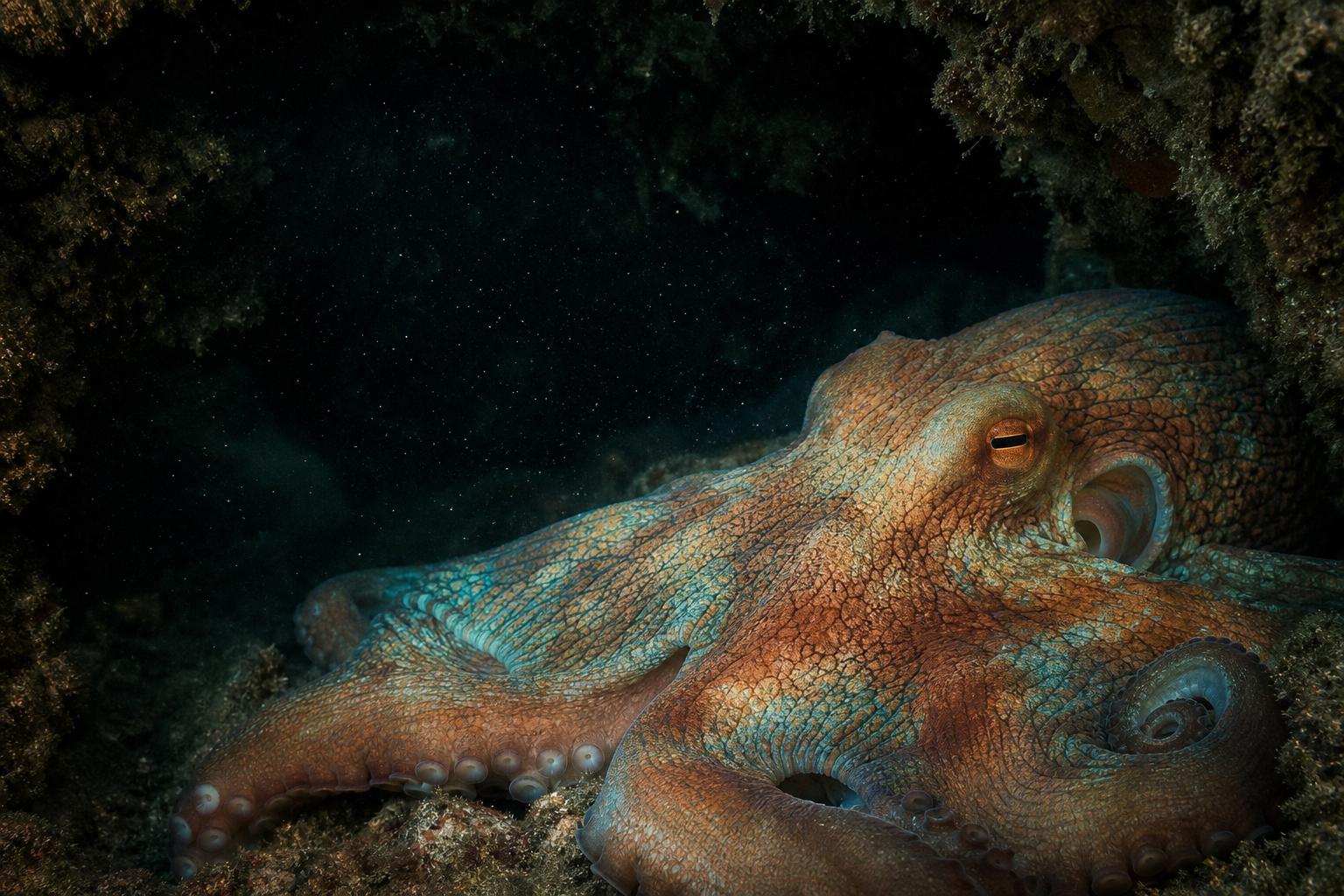
The Signal
An octopus can rest almost motionless, then shift into a brief active sleep state where the skin begins to change.
Researchers have observed rapid changes in color and texture during these active sleep periods, along with movement and arousal patterns that differ from quiet sleep.
The careful point is not that octopuses definitely dream like humans. The stronger point is that octopuses show a complex sleep state where the body and brain can become active in a way that makes dream-like processing scientifically plausible, but still unproven.
Why It Matters
Octopuses are separated from humans by hundreds of millions of years of evolution, yet they show signs of sophisticated behavior, learning, memory, and now complex sleep states. That makes them one of the strangest mirrors we have for asking how many different forms intelligence can take.
What The Research Says
Octopuses have been observed alternating between quiet sleep and active sleep. During quiet sleep, the animal can appear still and pale. During active sleep, researchers recorded rapid changes in skin color and texture, along with eye and mantle movement.
A 2021 iScience study on Octopus insularis described these two sleep states and found that active sleep was short, recurring, and behaviorally distinct from quiet sleep.
A 2023 Nature study went further by examining Octopus laqueus and reporting that active sleep includes wake-like skin patterning and neural activity. The researchers found that active sleep involved skin patterns resembling those seen while the animals were awake.
The careful claim is not that octopuses definitely dream. The safer claim is that octopuses show a complex active sleep state with body patterns and brain activity that make dream-like processing scientifically plausible, but still unproven.
Evidence Pack
- Medeiros et al., iScience, 2021: octopuses alternated between quiet sleep and active sleep, with active sleep showing dynamic skin color, texture changes, eye movement, and mantle movement.
- Pophale et al., Nature, 2023: active sleep in octopuses involved wake-like skin patterning and neural activity, including activity in brain regions associated with learning and memory.
- The 2023 Nature study suggests convergent features of complex sleep across very distant branches of animal evolution.
- The word "dream" should be used carefully. The visible skin patterns are evidence of an active sleep state, not direct evidence of subjective experience.